Middle school is when math shifts from basic arithmetic to abstract concepts, and estimating square roots is often a student's first real encounter with irrational numbers. An estimating square roots worksheet for middle school students helps bridge the gap between simply memorizing perfect squares and understanding where non-perfect roots actually belong on a number line. Instead of just pushing buttons on a calculator, students learn to build genuine number sense.
What exactly are students estimating?
At this grade level, the goal is not to find the exact decimal expansion of a number like the square root of 10. Instead, students learn to identify the two consecutive integers that the root falls between. They figure out that since 10 is between the perfect squares 9 and 16, its square root must be somewhere between 3 and 4. Taking it a step further, they might estimate that it is closer to 3.1 or 3.2. This logical progression builds a foundation for more advanced algebra later on.
When should teachers use these practice sheets?
Educators usually hand out these assignments right after introducing the concept of perfect squares. It is highly effective for formative assessment to see who understands the concept and who is still confused. You can use them as daily warm-ups, homework assignments, or partner activities. If you want to transition from paper to digital, leading an interactive digital group activity can help visual learners see how the numbers move along the axis.
How do you build number sense without a calculator?
A standard worksheet should gradually increase in difficulty. Start by asking students to identify the bounding integers. For example, ask them to name the two whole numbers surrounding the square root of 20. Next, have them plot those values on a visual scale. Showing students how to place values by visualizing perfect squares on a number line makes the abstract idea much more concrete. Finally, ask them to estimate the value to the nearest tenth.
What common mistakes do middle schoolers make?
One of the most frequent errors is dividing the number by two instead of finding the square root. A student might see the square root of 10 and immediately write down 5. Another common issue is assuming that a number like the square root of 12 sits exactly halfway between 3 and 4. Students often forget that 12 is much closer to 9 than it is to 16, meaning the root should be physically closer to 3 on their page.
To fix these misunderstandings, provide worksheets that require students to show their work. Having them write out the perfect squares below the radicals forces them to slow down and process the relationship between the numbers. Providing targeted practice materials for middle schoolers that focus specifically on these comparisons prevents them from rushing to wrong answers.
How can you make the worksheets more engaging?
Math worksheets do not have to be boring. You can include riddles where the estimated values correspond to letters that spell out a joke. Another option is to use color-by-number activities where students shade regions based on whether the root is closer to the lower or upper integer. When designing your own printable materials, using a readable, friendly typeface like Fredoka One can make the math problems feel less intimidating for younger readers.
Next steps for your lesson plan
- Ensure students have fully memorized perfect squares up to 225 before introducing non-perfect roots.
- Always require students to write the bounding perfect squares beneath the radical symbol on their worksheets.
- Use physical number lines on the classroom floor or wall so students can physically stand on the estimated values.
- Pair struggling students with peers to explain their mathematical reasoning out loud.
- Introduce the Pythagorean theorem only after students consistently estimate roots to the nearest tenth without a calculator.
 Partner Activity Worksheet for Estimating Square Roots
 Interactive Lesson: Estimating Square Roots with Whiteboards
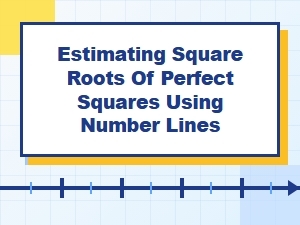 Estimating Square Roots with a Number Line
 Applying Square Roots to Real-World Problems Worksheet
 Estimating Square Roots with Decimals for Eighth Grade
 Exploring Fractional and Decimal Square Roots